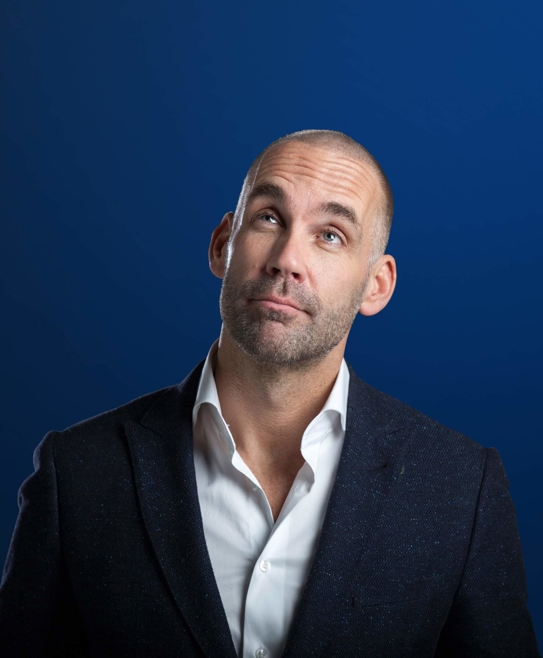
With the introduction of the smartphone and the tablet, our society has entered a rapid acceleration: from linear to exponential. We consume information in real-time and 24/7. We can no longer live without it. Everyone is addicted to information. We constantly want to be interrupted by a text message, a WhatsApp message, a Facebook post, or a tweet. Twitter, Facebook, Google, and Snapchat control our data and are the modern drug dealers of our digital consumer society. And we are only at the beginning: artificial intelligence, virtual reality, CGI influencers, 3D printing, brain interfaces, bitcoin & blockchain, robots, big data, privacy, and the Internet of Things. All these technologies are currently experiencing an exponential growth curve and are blending into one another. They reinforce each other and create a perfect digital storm that wreaks havoc on businesses. All these new technologies leave a lasting impact on the way we collaborate and physically organize the world. No longer thinking in terms of silos and securing knowledge within company walls, but rather seeking external collaboration to share knowledge and learn from each other. The future is thus the opposite of the past: we are moving from centrally controlled to decentralized organization. No wonder that the lifespan of companies is decreasing at a rapid pace. Companies cannot keep up with this relentless pace. After all, companies are trying to maintain the problem for which they were once the solution. While companies must now adopt new technologies in order to change themselves. After all, it is Digital Darwinism: adapt or perish! What is the impact of this digital transformation on people, companies, and society? In a rapid pace, futurist Sander Duivestein shows which trends are "hot" and which are "not," and where the opportunities and threats lie for the near future.
Marrying with an avatar, advertising campaigns with virtual stars, and concerts featuring holograms. The phenomenon of virtual celebrities and digital people is not new. In the 1990s, the MTV generation was already confronted with Max Headroom. Several digital characters are now able to reach millions of people with their talents. For example, the fully animated band Gorillaz, consisting of four cartoon characters, has already won a Grammy Award, Terre des Hommes has tracked down thousands of web sex tourists in its fight against child exploitation with the digital lure girl Sweetie, and CGI Influencer Lil Miquela now has over 1.5 million followers on Instagram. In the current Post-Truth era, we all have the tools at our fingertips to create avatars of ourselves and others. With DeepFakes, we can place the faces of celebrities on the bodies of porn stars, and with Lyrebird, we can clone our voices. Thus, we create a hyperreality in which what is real and what is not intertwine. How will we know what is authentic and what is not? What happens to people, companies, and our society when the boundaries between physical reality and digital reality blur?
Sociologists agree: generations are formed during the so-called "formative years." This takes place between the ages of 10 and 25. Events hit harder during this time. The frontal cortex is still developing. The stimulation center has life in its grip. In these formative years, children today develop in two ways: physically and digitally at the same time. They know no era without the internet. The concept of "digital transformation" holds no meaning for them. They have always been online; they are, as it were, "onlife." The internet is a post-modern candy store where every reality can be realized, but it is also a place where moral fog hangs, and they must figure out the rules of behavior themselves. Above all, they are the first generation that already has a business impact before their career has actually begun. They grow up as 'influencers' and experiment with new media, such as Mukbang, ASMR, and eSports. They are the creators of our future and the new employees of your company. What can we learn from this new generation?
Trust in companies, government agencies, and brands has reached a historic low. Various leaders have fallen from grace in recent years: Volkswagen's cheating software, bribery scandals at FIFA, Brexit, child abuse within the church, the massive hacking of credit card data at Equifax and Yahoo, #MeToo, the Paradise Papers, and at the end of 2018, the uprising of Les Gilets Jaunes against the elite. At the same time, we see that more and more people blindly trust what algorithms present to us. We get into a stranger's car, whose driver we do not know, because Uber's algorithms give him a high score. We invite unknown people to stay overnight in our bedroom because Airbnb's algorithms guarantee the reputation of these guests. We find our life partner with a swipe of our fingers because Tinder's artificial intelligence matches this person to our preferences, and we transfer bitcoins to each other without the intervention of trusted intermediaries. We are moving from centrally controlled organizations to decentralized networks, where advanced artificial intelligence knows our deepest needs and desires and responds to them in a human-centered way. What does this transition mean for people, companies, and governments? Can we blindly trust the algorithms, or are they biased? What does it mean when access is more important than ownership? What does our economy look like when our digital reputation is the new currency?