What does it mean today to be part of “the third generation” after the Holocaust?
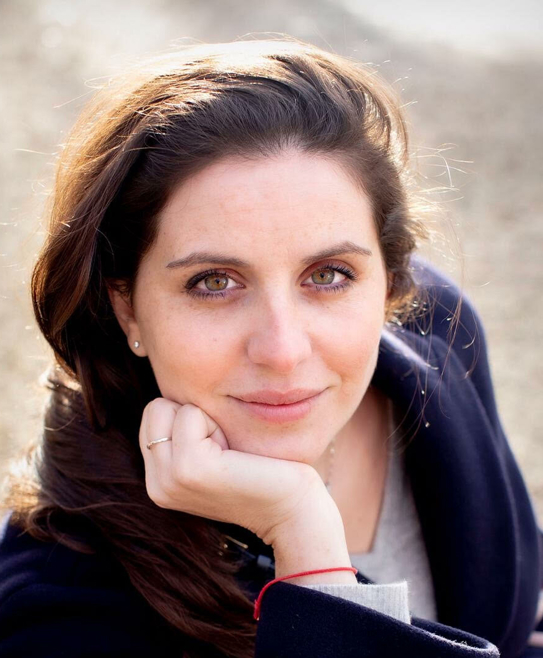
Natascha van Weezel (1986) is a writer, columnist, and filmmaker. She is the daughter of the renowned parliamentary journalist, radio presenter, and writer Max van Weezel, who passed away in 2019, and Annet Bleich, who wrote for de Volkskrant for many years. Natascha is also the granddaughter of four Jewish grandparents who survived the war by fleeing and going into hiding.
In 2015, she wrote the moving book De Derde Generatie – Kleinkinderen van de Holocaust about what it means to be part of “the third generation.” In this lecture, the story also begins with her moving family history, which she connects to current events. In particular, she addresses the way extremist views on the political spectrum are increasingly gaining ground, resulting in heated confrontations in public spaces.
In this lecture, Natascha shares her own experiences as the grandchild of Holocaust survivors. Can a war affect you if you did not experience it yourself? However, she places the story of the Holocaust and her own grandparents in a much broader context. Unfortunately, the Second World War was far from the last war. Even today, a war is raging on our continent. What will happen later in life to the people experiencing this now? And what can we as a society do to help?
Natascha also shares her knowledge of scientific research into intergenerational trauma. For example, did you know that research has been conducted on the descendants of deer that were near the Berlin Wall around November 9, 1989? Even seven generations later, these deer still react more fearfully than their counterparts.
Finally, Natascha addresses the culture of remembrance. The Second World War was “already” 80 years ago. Should we still commemorate it? And for how long? If so, what is the importance of remembrance? Should we find new forms of commemoration and involve other groups, or should we not? But most importantly: what lessons can we still learn today from a war that now seems so long ago?
This lecture/workshop is also highly suitable for schools and organizations that find it difficult to engage their students or employees in conversations about these topics.
At the age of twenty, Natascha made her debut with the book Magere Jaren. It was a diary she kept from the age of 14 to 19. Her diary was different from those of other girls.
She did not write only about boys and going out, but mainly about the eating disorder she suffered from: anorexia nervosa.
In this lecture/workshop, she shares her story about her eating disorder. What happened before it developed? When was the moment things really started to go in the wrong direction? And how did she eventually recover? Or perhaps the more interesting question: can you ever fully recover from an eating disorder?
One thing Natascha quickly learned was that overcoming the illness requires perseverance—and, in a way, so does developing it. For years, she lived on a bowl of yogurt and a little fruit. Not necessarily because she wanted to be thin, although she believed that at the time, but mainly because she wanted to maintain control. Control over a world she found terrifying. Eventually, Natascha was admitted to a clinic, where she stayed for six months. Slowly but surely, the light began to shine again.
Natascha can give this workshop/lecture to healthcare organizations, therapists, students, school principals, insurance companies, youth care organizations, municipalities, dietitians, and more. She can focus entirely on eating disorders, but she can also broaden the lecture to the theme of resilience. Because after recovering from her eating disorder, life naturally continued—with both positive and difficult experiences.
In 2018, everyone was convinced that she would relapse into her eating disorder. Her father was diagnosed with pancreatic cancer, and her then-partner, with whom she lived and with whom she was trying to have children, suddenly told her that he no longer loved her. She was living in his house and had to leave immediately. Natascha had never felt so miserable. Her father was seriously ill, her relationship ended, she became a caregiver and was temporarily unable to work, she no longer had a home, and after a terrible year of illness, her father passed away. Yet she did not relapse. Somehow, she managed to stay on her feet. She discovered the secret weapon she should have used earlier to overcome her illness: resilience.
Resilience is something intangible. We all have it, but not everyone can easily find it within themselves. In this lecture, Natascha explains what resilience actually is and how you can learn to tap into it. It does not necessarily make life easier, but it can help you move forward. And that is what she has done: she now has a wonderful home, the best job in the world, a husband, and a baby. She still misses her father every day, and her life is certainly not perfect every day. But she knows how strong she is—and, in fact, everyone has that strength; you simply have to learn to recognize it in yourself. Natascha is happy to help people do just that.
Natascha van Weezel is a writer, filmmaker, and columnist for Het Parool. From a young age, she has had a strong interest in the subject of polarization. Why do some groups end up completely opposed to one another? Can we still disagree with each other in this country without resorting to insults? When does someone become an enemy? What problems does this kind of enemy thinking create? And most importantly: how can we break this cycle? Now that anti-institutional extremism is increasing, these questions are more relevant than ever for businesses, schools, government organizations, and municipalities.
Drawing on a personal story about her Jewish family history and the lessons she learned at a young age in Israel—if there is one highly polarized country, it is Israel—Natascha explains the dynamics behind polarization in the Netherlands. She also engages in dialogue with the participants. What prejudices exist within this group? How do they view increasing hostility on social media? And do the participants themselves ever experience the negative consequences of (online) polarization?
As a dialogue facilitator, Natascha has extensive experience creating a safe atmosphere within groups of all sizes. Expect an interactive session full of personal stories and experiences. At times confronting, but always constructive and hopeful. Because ultimately, we are all capable of building bridges in a world that increasingly seems divided.