
Victor-Lamme-info-1.jpg
Speaker

Victor Lamme

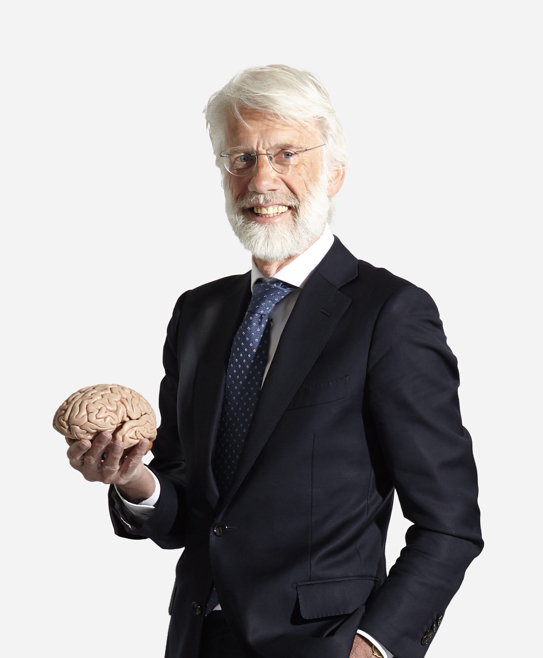
Speaker Victor Lamme is Professor of Cognitive Neuroscience at the University of Amsterdam and an expert in perception and consciousness. He writes columns and is working on a popular science book about consciousness. His lectures are always filled with images, films, and experiments that the audience can actively participate in. He has a unique ability to translate his knowledge of the brain into practical insights for audiences on stage, on television, and on the radio. Victor is available to book as a speaker through Sprekershuys.

  • Rate indication: € 3,500 to € 4,999
  • Available for booking as: Speaker
  • Languages: Dutch English

Speaker Victor Lamme is a renowned brain researcher whose work has been published in scientific journals such as Nature and Science. He has also written the popular bestsellers ‘De Vrije Wil Bestaat Niet’ and Why?, in which he demonstrates how brain research sheds new light on who we really are. Victor Lamme is also a professor and brain researcher in the Department of Psychology at the University of Amsterdam.

Victor Lamme has a unique ability to translate his knowledge of the brain into practical insights and is therefore a highly sought-after guest on stages, radio, and television. The lectures of speaker Victor Lamme are packed with surprising insights for marketers, managers, businesses, government, and anyone else who wants to effectively influence human behavior.

Webinar Victor Lamme

Victor Lamme’s webinar The Brain in Times of Crisis is both inspiring and practical. “Which buttons can I press to influence behaviour from a distance (1.5 metres)?”

What does a crisis such as the coronavirus pandemic do to our brains? And how can we ensure that people remain mentally fit and motivated during times like these? Both remote workers and people in essential professions are confronted with major changes, sometimes intense emotions, and in any case a situation that requires significant adjustments.

This requires very different brain processes from those we are accustomed to using. In this webinar, Victor Lamme explains how our brains work in times of crisis and how we can use this knowledge to optimally deal with the challenges we face. How can I communicate effectively with people, what works and what does not? How can I influence behaviour and the choices people make, and how do I deal with emotions from a distance of 1.5 metres or more? In short, how can I still press the right buttons in the brain of my customer, employee, citizen, or patient? Learn all about how a crisis exposes the fundamental drivers behind our behaviour, while also having a little laugh at ourselves!

Lecture Victor Lamme

Victor Lamme enjoys speaking to general audiences, companies, and professional conferences. His lectures are always interactive multimedia experiences, featuring plenty of images, films, and experiments in which the audience can actively participate. Expect an unexpected or even provocative perspective, always supported by arguments, while providing plenty of food for discussion.

Sessions

What does a crisis such as the coronavirus pandemic do to our brains? And how can we ensure that people remain mentally fit and motivated during times like these? Both remote workers and people in essential professions are confronted with major changes, sometimes intense emotions, and in any case a situation that requires significant adjustments. This requires very different brain processes from those we are accustomed to using. In this webinar, Victor Lamme explains how our brains work in times of crisis and how we can use this knowledge to optimally deal with the challenges we face. How can I communicate effectively with people, what works and what does not? How can I influence behaviour and the choices people make, and how do I deal with emotions from a distance of 1.5 metres or more? In short, how can I still press the right buttons in the brain of my customer, employee, citizen, or patient? Learn all about how a crisis exposes the fundamental drivers behind our behavior, while also having a little laugh at ourselves!

With the advent of brain scans, it became possible for the first time to directly measure the impact of advertising, packaging, and design on the consumer’s brain. Learn why asking consumers questions reveals so little about consumer behaviour and why 80% of products launched on the market consequently fail. Discover which buttons in the consumer’s brain need to be pressed for effective marketing, as well as the latest developments in applying neuroscience to marketing.

Nowhere is it more apparent that people do not act rationally than in economics. Why do people make such strange financial decisions? Why do they fail to save for retirement? And why are they generally such poor investors? Discover that the brain is a fantastic device, but completely unsuited to dealing with money. Learn how to avoid the pitfalls that the brain creates for us.

Seeing something that appears in front of you seems like the simplest thing in the world. Yet it is one of the greatest mysteries. Everyone has their own interpretation of reality, which has major consequences for the experience of art, architecture, and design. Discover the principles that determine whether an image is noticed and strikes the right chord in the brain.

What really underlies our behavior? Who makes the decisions in our minds? From sleepwalking murderers and unconscious influence to ‘Mart Smeets’: the little person in our head who thinks they know why we do what we do, but is little more than a commentator on the brain processes that actually determine our behavior. Leave the room with the realization that we are much more than our thoughts.

Neuroscience concludes that free will does not exist. What consequences does this have for the legal system? Is no one responsible for what they do anymore? Or should we move towards a different system of judgment and punishment, in which accountability has a completely different meaning? Legal professionals are at the forefront of integrating insights from neuroscience into society.

A million books have already been written about management, but the essence is this: anyone who wants to manage people needs to understand how to influence their brains. Discover why talking does not help and which methods are effective in influencing behavior. Anyone who knows the three buttons in the brain that determine human behavior knows what to do to effectively influence people towards productive behavior. Because free will does not exist.

People are creatures of habit, and nothing seems more difficult than breaking deeply ingrained routines. How can you truly encourage people to change their behavior? Whether it concerns the environment, how we interact with others, food, quitting smoking, dealing with money, or what we do in traffic, the key to effective behavioral influence is to align with the mechanisms in people’s brains rather than work against them. That is why awareness alone is ineffective, while nudging works. Learn how to effectively influence the behavior of others by recognizing and engaging with people’s deepest motivations.

Why do people choose a job? Research shows that the choices people make are influenced by various unconscious brain processes and irrational emotions. Victor Lamme explains what happens inside our brains and how you can use this knowledge to better understand people, thereby making yourself a more attractive employer. A good employer knows how to find the ‘right buttons’ in employees’ brains, so that they are eager to perform at their best, line up for a job, and never want to leave once they are inside. What are neuromanagement and neuromarketing? How do you actually get people moving? How do you build trust? How do you manage change or encourage employees to reach greater heights? In this interactive masterclass, learn all about behavioral influence, while also having a little laugh at yourself!

Science has described consciousness as one of the last remaining great mysteries of the universe. How is it possible that we have conscious experiences with just one and a half kilograms of fat and proteins in our heads, while seemingly much more complex machines do not? What happens when consciousness disappears, such as during sleep or in a patient in a coma? Does a soul exist after all? Join this fascinating exploration of the wonder that takes place inside everyone’s head.

Nothing is more important to a company or institution than trust. The new buzzword is ‘transparency’: if we simply tell people exactly what we do and why, trust will follow automatically. Neuroscience and psychology, however, tell a very different story. Trust is an irrational emotion, and transparency can actually undermine trust between people. Learn which buttons you should press to build trust among people and consumers.

For around fifteen years, brain scans have been used to better understand the brain. More recently, an exciting development has emerged: using brain scans to directly read thoughts, preferences, and memories—consciously or unconsciously—from the brain. This allows us to learn more about what is still happening in the brain of a patient in a coma, what someone truly likes, and whether someone has knowledge of a crime that has been committed. Even observing what happens in someone’s dreams may be possible...

Videos

Customers rate our us with a grade of 9.2

  • Wide range of current speakers
  • Personal & non-binding advice
  • For every type of event